Coolant: what it is, where it goes, and what to do
In a hurry? Start here.
Coolant carries heat away from the engine. Check the reservoir only when the engine is fully cool; use the level marks and your manual.
Safety: If the gauge is hot, steam appears, or coolant keeps disappearing, stop safely and arrange an inspection.
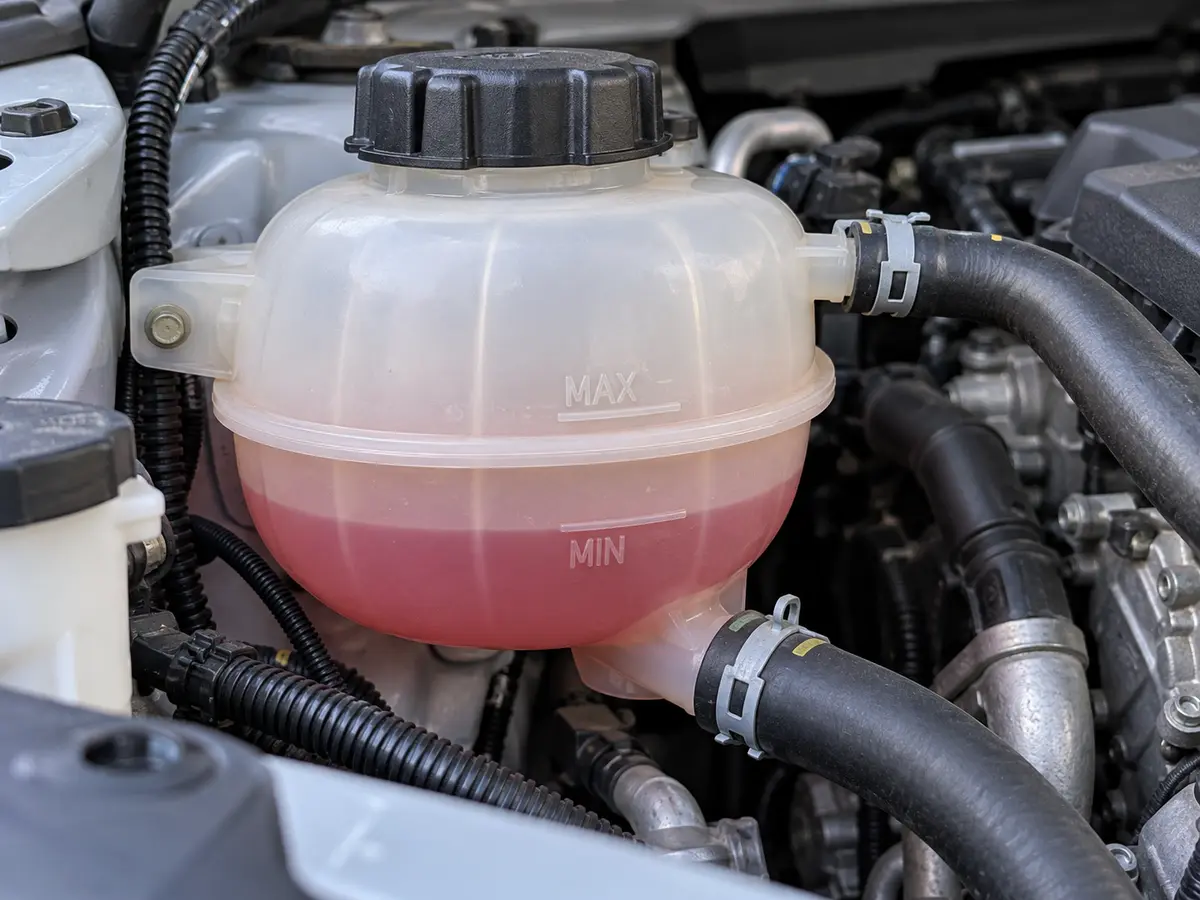
What the numbers point to
- The black cap sits on the coolant reservoir. Identify your own car’s reservoir in the owner’s manual; never open a hot cap.
- The side of this example has MIN and MAX marks. With the engine fully cool, look through the reservoir at the level and compare it with your car’s cold-level marks. This example appears near or below MIN, so it is not a target level.
Coolant color and reservoir shape vary. A low level or repeated loss needs an inspection; adding fluid does not fix a leak.
Engine coolant is the fluid that carries heat away from the engine through the cooling system. It also helps protect against freezing and corrosion. People often call it antifreeze; the bottle may be a concentrate or a ready-to-use mix. Use the type and mixture specified for your exact vehicle, not a guess based on color.
Find it without guessing
With the engine off and completely cool, open the hood and look for a translucent plastic coolant reservoir with level marks such as MIN/MAX, LOW/FULL, or COLD/HOT. Its shape and position vary. Use the diagram in your owner’s manual to identify it before opening anything. Do not confuse it with the windshield washer-fluid container, brake-fluid reservoir, or an electric vehicle’s separate cooling system.
Check the level safely
- Park on level ground and let the engine cool fully; follow the manual’s cold-engine check procedure.
- Look through the side of the reservoir at the fluid level. Compare it with the cold markings for your car. A level between the indicated marks is generally the target when cold.
- If it is below the low mark, look for a wet spot under the car, a sweet smell, steam, or a temperature warning. If any of these appear, arrange an inspection rather than treating a refill as the repair.
Never remove a radiator cap or pressurized coolant cap while the engine is hot. Hot coolant can spray out and cause severe burns. If the gauge climbs into the hot range or steam appears, pull over safely, shut the engine off, and seek help.
If it needs topping up
Use the coolant specification in your owner’s manual. A bottle labeled “prediluted” or “ready to use” is already mixed; concentrate needs the specified water and ratio. Only open the appropriate reservoir cap after the engine is fully cool, add slowly to the correct cold mark, and close the cap securely. Do not overfill. If you are unsure which reservoir or product is correct, ask a repair shop to check it.
If it keeps getting low
Coolant normally stays in a closed system. Repeated topping up, a visible puddle, a sweet smell, poor heater performance, or overheating can point to a leak or another cooling-system fault. Note when the level drops and ask a shop for a cooling-system pressure test. Do not keep driving an overheating engine.
AAA: check the coolant reservoir safely · AAA: choosing coolant